Trusted Pakistan Tax Platform
Understand Pakistan
Tax Laws Simply
Expert income tax & sales tax guides, calculators, and tutorials for salaried individuals, freelancers, and businesses — updated per FBR 2025–26.
500+
Clients Helped
50+
Tax Guides
200+
MCQs Available
5+
Years Experience
FBR Updated
Tax Year 2025–26
Free & Educational
Guides & MCQs
Smart Calculators
Salary, Business & AOP
Paid Consultation
Expert help — fast
Tax Guides
Featured Tax Guides
📋
Income Tax
Income Tax Basics for Salaried Individuals
Learn about income tax slabs, filer status, ATL benefits, and how to file your return with FBR IRIS portal.
📊
Sales Tax
Sales Tax Registration & Filing Guide Pakistan
Complete guide to GST registration, monthly filing on IRIS, and withholding obligations for businesses.
👨💻
Freelancers
Freelancer Tax Guide: How to File Tax in Pakistan
Upwork, Fiverr earners — understand your tax obligations, exemptions, and how to file with FBR.
Tools
Free Tax Calculators
Salary Tax Calculator
Calculate your income tax on salaried income using the latest 2025–26 FBR tax slabs instantly.
Calculate Now →
Business Tax Calculator
Estimate tax for sole proprietors & small business owners based on business income and expenses.
Calculate Now →
AOP Tax Calculator
Compute tax liability for Association of Persons (partnership firms) with updated AOP rates.
Calculate Now →
Latest Articles
Recent Tax Blog Posts
income tax
Advance Tax on Foreign Card Payments Section 236Y
Under Section 236Y ITO 2001, banks deduct advance tax on international payments made through Pakistani credit, debit and prepaid cards. …
income tax
Why Do People in Pakistan Want to Become Filers?
People become tax filers in Pakistan to save money — not pay more. Filers pay lower rates on property (1.5% …
sales tax
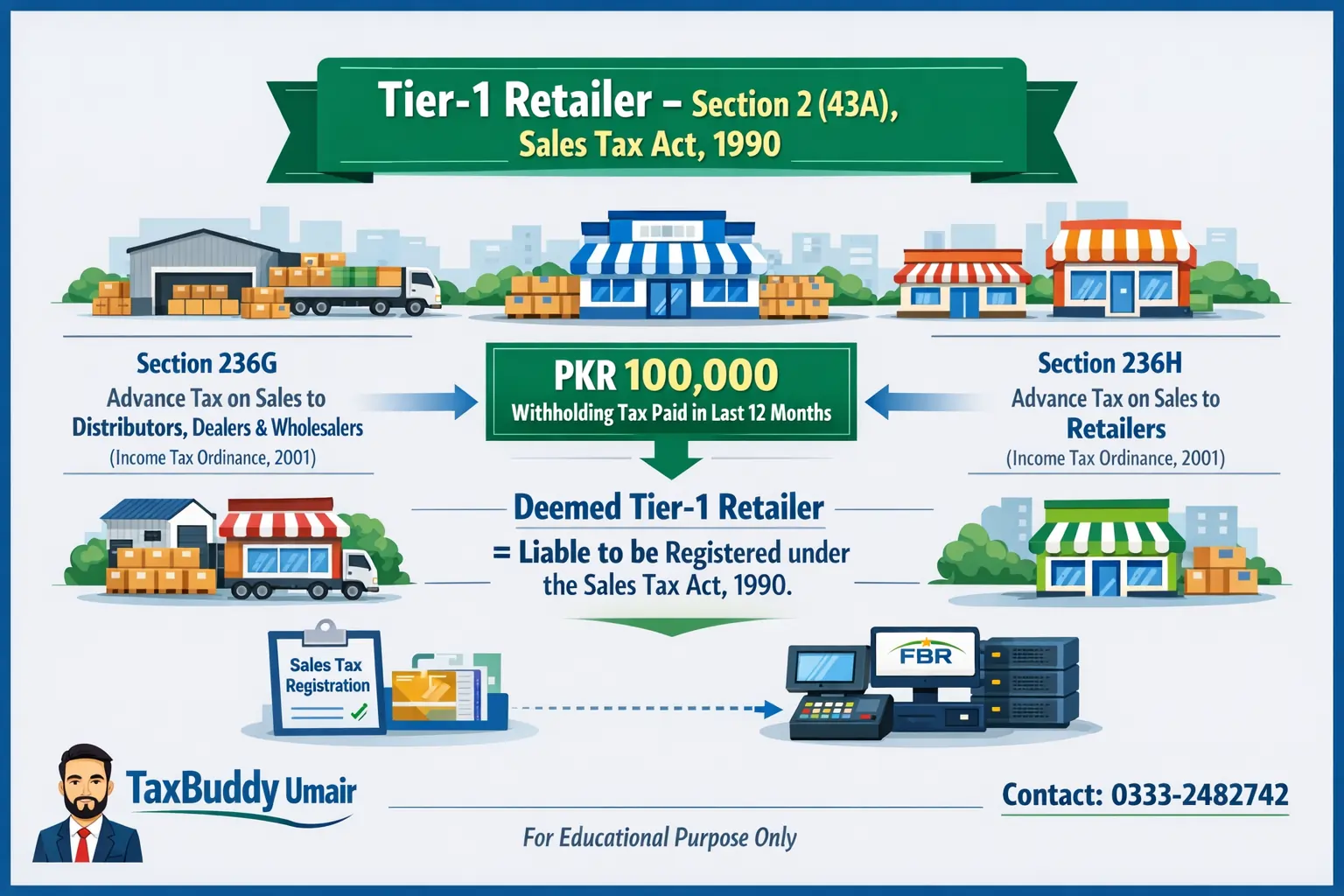
Do Bakery Shops Fall Under Tier-1 Retailers Pakistan
Find out if your bakery shop qualifies as a Tier-1 Retailer under Section 2(43A) of Pakistan's Sales Tax Act 1990. …
income tax
Joint Bank Account Profit on Debt Tax Pakistan
Under Section 151 ITO 2001, filers pay 20% and non-filers pay 40% tax on bank profit. For joint accounts, Rule …
sales tax
Who is not Liable to Register under Sales Tax Act 1990
Persons dealing exclusively in exempt supplies listed in the Sixth Schedule of the Sales Tax Act 1990 are not required …
sales tax
What is Value Addition Tax Sales Tax Act 1990 Pakistan
Learn how value addition tax works under Pakistan's Sales Tax Act 1990. Understand input tax, output tax, the formula Output …
FAQs
Frequently Asked Questions
Quick answers to the most common tax questions in Pakistan — based on the Income Tax Ordinance, 2001 and Sales Tax Act, 1990.
How do I check my ATL (Active Taxpayer List) status?
Visit www.fbr.gov.pk and search the ATL section, or send your CNIC number (without dashes) as an SMS to 9966. You will receive an instant reply. The ATL is updated every Monday by FBR.
What is the deadline to file an income tax return in Pakistan?
For salaried individuals and AOPs, the return filing deadline is September 30 of each year for the tax year ending June 30. Late filing attracts a penalty of Rs. 1,000 under Section 182 of the Income Tax Ordinance, 2001.
What is the penalty for not filing an income tax return?
A minimum penalty of Rs. 1,000 applies under Section 182. However the bigger cost is losing filer status — non-filers pay double withholding tax on property, bank profits, dividends, and card payments — costing hundreds of thousands of rupees annually.
What is advance tax on property sale (Section 236C) in 2025-26?
Under Section 236C, advance tax on property sale is: Filer = 4.5%, Late Filer = 7.5%, Non-Filer = 11.5%. On a Rs. 10 million sale, a filer pays Rs. 450,000 while a non-filer pays Rs. 1,150,000 — saving Rs. 700,000 by being a filer.
What is advance tax on property purchase (Section 236K) in 2025-26?
Under Section 236K, advance tax on property purchase is: Filer = 1.5%, Late Filer = 4.5%, Non-Filer = 10.5%. On a Rs. 10 million purchase, a filer pays Rs. 150,000 while a non-filer pays Rs. 1,050,000 — a saving of Rs. 900,000.
What is Section 7E — tax on deemed income from property?
Section 7E treats property as generating deemed income of 5% of its fair market value and taxes it. However, 9 categories are exempt including: persons owning only one property, self-used business premises (filers), agricultural land, Shaheed family properties, rented properties with tax paid, and all properties with aggregate FBR value below Rs. 25 million.
What are the salary income tax slabs for Tax Year 2025-26?
Salary tax slabs for 2025-26:
Up to Rs. 600,000 = 0%
Rs. 600,001 – 1,200,000 = 1% of amount exceeding Rs. 600,000
Rs. 1,200,001 – 2,200,000 = Rs. 6,000 + 11%
Rs. 2,200,001 – 3,200,000 = Rs. 116,000 + 23%
Rs. 3,200,001 – 4,100,000 = Rs. 346,000 + 30%
Above Rs. 4,100,000 = Rs. 616,000 + 35%
Up to Rs. 600,000 = 0%
Rs. 600,001 – 1,200,000 = 1% of amount exceeding Rs. 600,000
Rs. 1,200,001 – 2,200,000 = Rs. 6,000 + 11%
Rs. 2,200,001 – 3,200,000 = Rs. 116,000 + 23%
Rs. 3,200,001 – 4,100,000 = Rs. 346,000 + 30%
Above Rs. 4,100,000 = Rs. 616,000 + 35%
Is House Rent Allowance (HRA) taxable in Pakistan?
Yes. Cash House Rent Allowance is fully taxable as salary under Section 12 of the ITO 2001. There is no exemption for cash HRA. However, if your employer directly provides accommodation (a perquisite), it is valued at 45% of basic salary or actual rent — whichever is lower.
What is withholding tax on bank profit (Section 151)?
Under Section 151, banks deduct withholding tax on profit from savings accounts, term deposits, and PLS accounts. Rates: Filer = 20%, Non-Filer = 40%. This tax is adjustable in your annual return. On Rs. 500,000 bank profit, a filer pays Rs. 100,000 while a non-filer pays Rs. 200,000.
What is advance tax on international card payments (Section 236Y)?
Under Section 236Y, banks collect advance tax on international payments via Pakistani credit, debit, and prepaid cards. Rates: Filer = 5%, Non-Filer = 10%. This applies to online shopping, travel bookings, Netflix, Amazon, university fees, and all foreign transactions. Tax is adjustable in annual return.
What is the GST rate in Pakistan?
The standard General Sales Tax (GST) rate is 18% under Section 3 of the Sales Tax Act, 1990. Three types of goods exist: Taxable (18%), Zero-Rated (0% — mainly exports, input tax refundable), and Exempt (Sixth Schedule — no GST, no input tax claim).
What is Further Tax (4%) under the Sales Tax Act, 1990?
Under Section 3(1A), registered persons making taxable supplies to unregistered buyers must charge an additional 4% Further Tax. This makes the total tax rate 22% (18% + 4%). Its purpose is to encourage buyers to register for sales tax.
What is the difference between a filer and a non-filer in Pakistan?
A filer appears on FBR's Active Taxpayer List (ATL) by filing their annual income tax return. A non-filer has not filed and faces double or higher withholding tax rates on property (11.5% vs 4.5%), bank profits (40% vs 20%), dividends (30% vs 15%), and card payments (10% vs 5%). Filing a return — even a Nil Return — gives full filer status.
What is withholding tax in Pakistan?
Withholding tax is income tax deducted by the payer at the time of making a payment and deposited with FBR on behalf of the recipient. The recipient receives the net amount. At year-end, the withheld amount is credited against the recipient's annual tax liability. Key sections: 149 (salary), 150 (dividends), 151 (bank profit), 236C (property sale), 236K (property purchase).
Have more questions? Ask on WhatsApp →
Contact
Need help with tax filing?
Get expert assistance from Umair Mubeen, a tax educator & content creator based in Karachi.
📞
Phone / WhatsApp
+92 3332482742
✉️
Email
umair.mubeenir@gmail.com